Christian Teaching of Nonresistance and Forgiveness
Native SonThe Christian Teaching of Nonresistance and Forgiveness is Reverend Hammond’s doctrine of accepting suffering, renouncing hatred, and seeking salvation through Jesus rather than resisting the world’s cruelty. In his appeal to Bigger, it offers spiritual consolation and eternal hope; set against the novel’s account of racial oppression, however, it also raises a question the sermon does not resolve: whether endurance can answer harms built into ordinary social arrangements.
The Doctrine of Suffering and Salvation
Reverend Hammond explains human suffering through the story of the Fall. Humanity’s desire for knowledge leads out of the garden and into a world of labor, pain, and struggle. He then presents Jesus’ crucifixion as the way back to God: Christ accepts death, and that death becomes a victory that shows believers how to meet a hostile world. In this teaching, earthly life is not the final home, and suffering is not proof that divine love has failed.
The sermon’s practical demand follows from this theology. Reverend Hammond urges Bigger to stop hating long enough for God’s love to enter his heart, and asks him to try to believe. Love, forgiveness, and faith—not retaliation—are offered as the way through suffering and toward eternal life. The rule is therefore both spiritual and behavioral: it asks the sufferer to relinquish hatred and resistance, not merely to believe that suffering has meaning.
The Appeal to Bigger
The teaching is delivered to Bigger in prison, where Reverend Hammond asks him to turn toward faith. Bigger does not answer the request to promise that he will try. He covers his eyes, and the narration makes clear that repeated questioning is bringing him close to striking the preacher. His resistance is bound to his guilt: he cannot believe in what he has killed. The scene places the doctrine’s demand for forgiveness beside a listener who is unable to receive it as simple comfort.
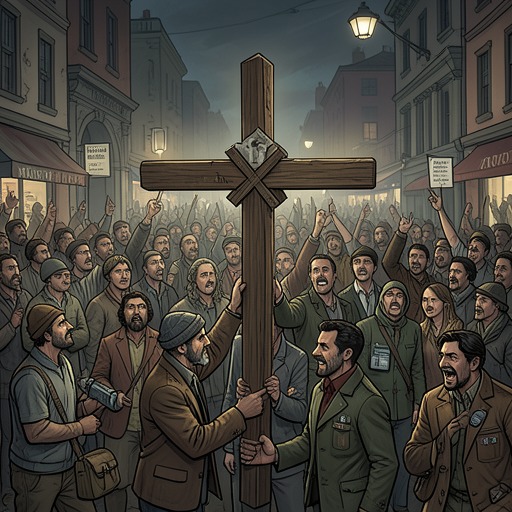
Reverend Hammond gives Bigger a small wooden cross on a chain. He interprets the cross as a sign of the world and of the suffering imposed on human life, then urges Bigger to look at it when alone and believe. The object makes the sermon tangible: Bigger wears its promise against his skin, yet possession does not establish that he accepts the faith it represents. In the silence that follows, he feels the preacher’s image of life as flesh nailed to the world and of a spirit confined within earthly days. The cross thus carries both the minister’s message of consolation and the weight of suffering Bigger already recognizes.
Endurance and Social Conditions
The novel places this religious appeal alongside a distinct account of the forces shaping Black life. In questioning Mr. Dalton, Max challenges the higher rents charged to Black families and asks whether the company’s policy keeps them concentrated on the South Side. The exchange directs attention away from individual charity alone and toward housing practices that help maintain segregation.
In court, Max likewise asks the audience not to reduce Bigger’s case to personal injustice or to the emotional spectacle of mob fear. He argues that Black people have been directed where to live, what schooling to receive, and where and what kind of work they may do. He also points to the segregated seating in the courtroom itself: Black spectators sit together because they know they are not wanted on the same bench as white spectators. These observations describe social restrictions as persistent conditions, not merely as isolated acts of personal hostility.
The Rule’s Tension and Significance
Reverend Hammond’s teaching treats suffering as a spiritual trial to be met with love and nonresistance. Max’s courtroom argument, by contrast, insists that the conditions producing fear and deprivation must be recognized and changed. The two accounts address different levels of experience: one offers an individual practice of faith, while the other names collective restrictions in housing, education, work, and public life. The novel does not make the sermon equivalent to a policy for ending those restrictions, nor does the available scene show Bigger accepting its demand.
That tension gives the teaching its significance. The cross can promise meaning to a person facing suffering, but the courtroom scenes show why consolation and structural change are not interchangeable. By placing Reverend Hammond’s appeal beside Max’s challenge to segregated life, the narrative tests the reach of forgiveness: it may offer a way to live with pain, while leaving open the demand to confront the social arrangements that keep producing it.